What AI Inventory Management Actually Means for Independent Retail (and What It Does Not)
Every vendor now says they have AI. For independent retailers, AI in inventory management means one thing: your POS data getting turned into a ranked decision list without a consultant in the loop. Here is what to look for.

Michael Shahid • Founder & CEO
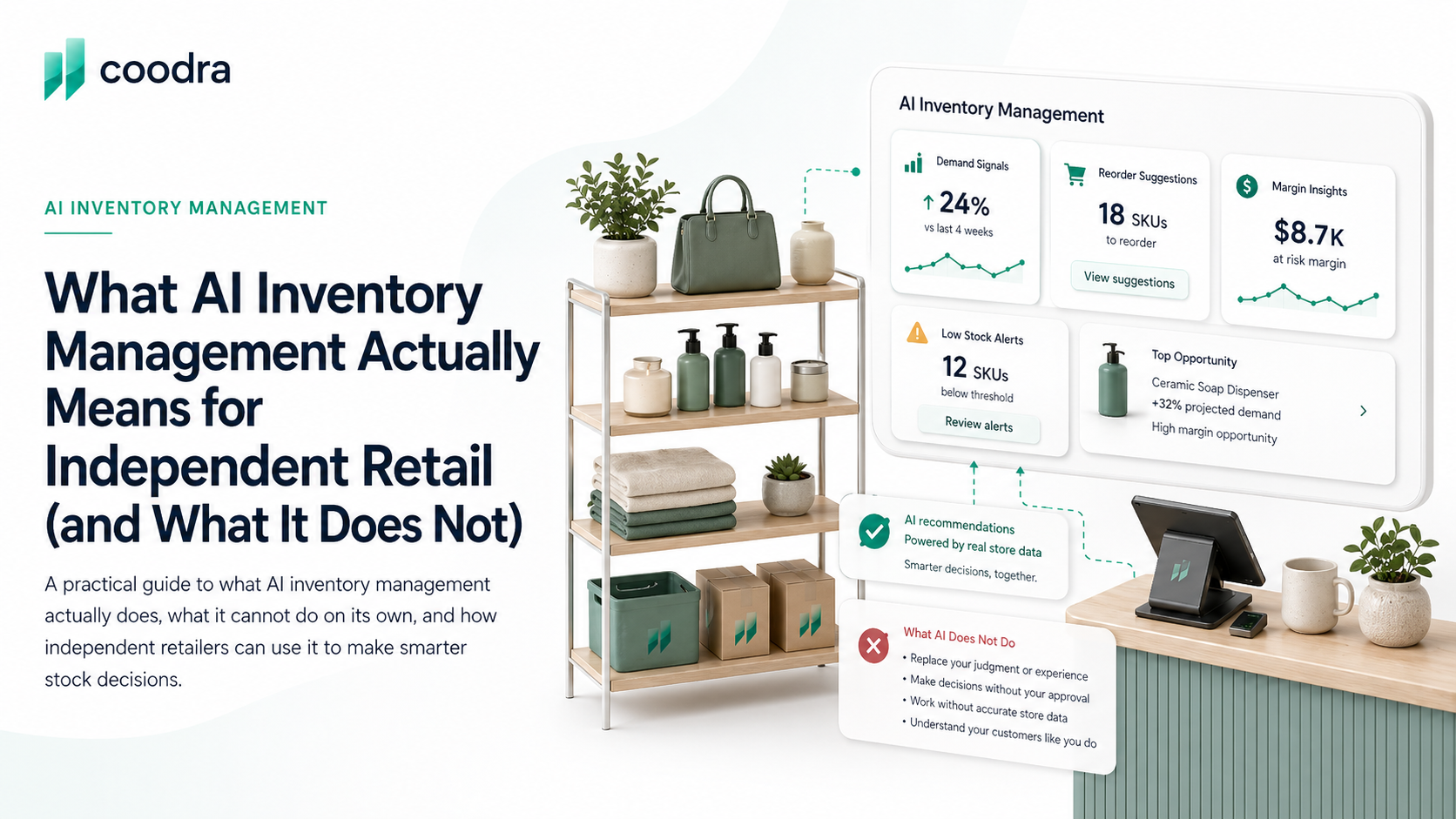
Search for inventory management software and every vendor now has AI. Machine learning models, demand forecasting engines, predictive replenishment. The term is everywhere. For independent retailers trying to separate signal from noise, it is increasingly hard to know what it actually means — and whether any of it is relevant to a 2-location jewelry store or a single-location pet shop running Square.
This post is an honest accounting of what AI in inventory management actually does for independent retail, what it does not do, and what to look for when a vendor says their software is review-first.
What AI inventory management means for independent retailers
For independent retail, AI inventory management is not a forecasting model that requires months of training data, a data science team, or an ERP backend. It is a specific type of automation: taking the raw signal from your POS — what sold, what is on hand, what is trending — and converting it into a ranked decision list without a human having to run the numbers first.
That is the practical definition. The POS generates data continuously. A true AI inventory management system for independent retail takes that data stream and does something useful with it: surfaces the SKUs that need attention this week, scores them by urgency and margin impact, and presents them as a clear action list — not a dashboard to explore.
The key qualifier is "for independent retail." Enterprise AI inventory tools do something different: they run statistical demand forecasting models across thousands of SKUs, optimize inventory positioning across multiple warehouses, and generate purchase orders automatically based on forecasts weeks or months in advance. That is AI for a different operational scale. Independent retailers do not need multi-warehouse optimization. They need one store's worth of decisions, ranked.
The specific AI signals that actually matter for small retail
For a retailer running Shopify, Square, or Lightspeed, there are three AI-generated signals that directly change outcomes. Everything else is enterprise-grade complexity that a 2-location retailer does not need.
Signal 1: Velocity trend detection. Your POS knows what sold last week. AI velocity trend detection knows whether that number is normal, climbing, or declining — and whether the change is noise or signal. A product selling 20 units this week versus 18 last week is noise. A product selling 20 units this week versus 12 four weeks ago is a trend. AI catches that distinction automatically, across all your SKUs, without you running a report.
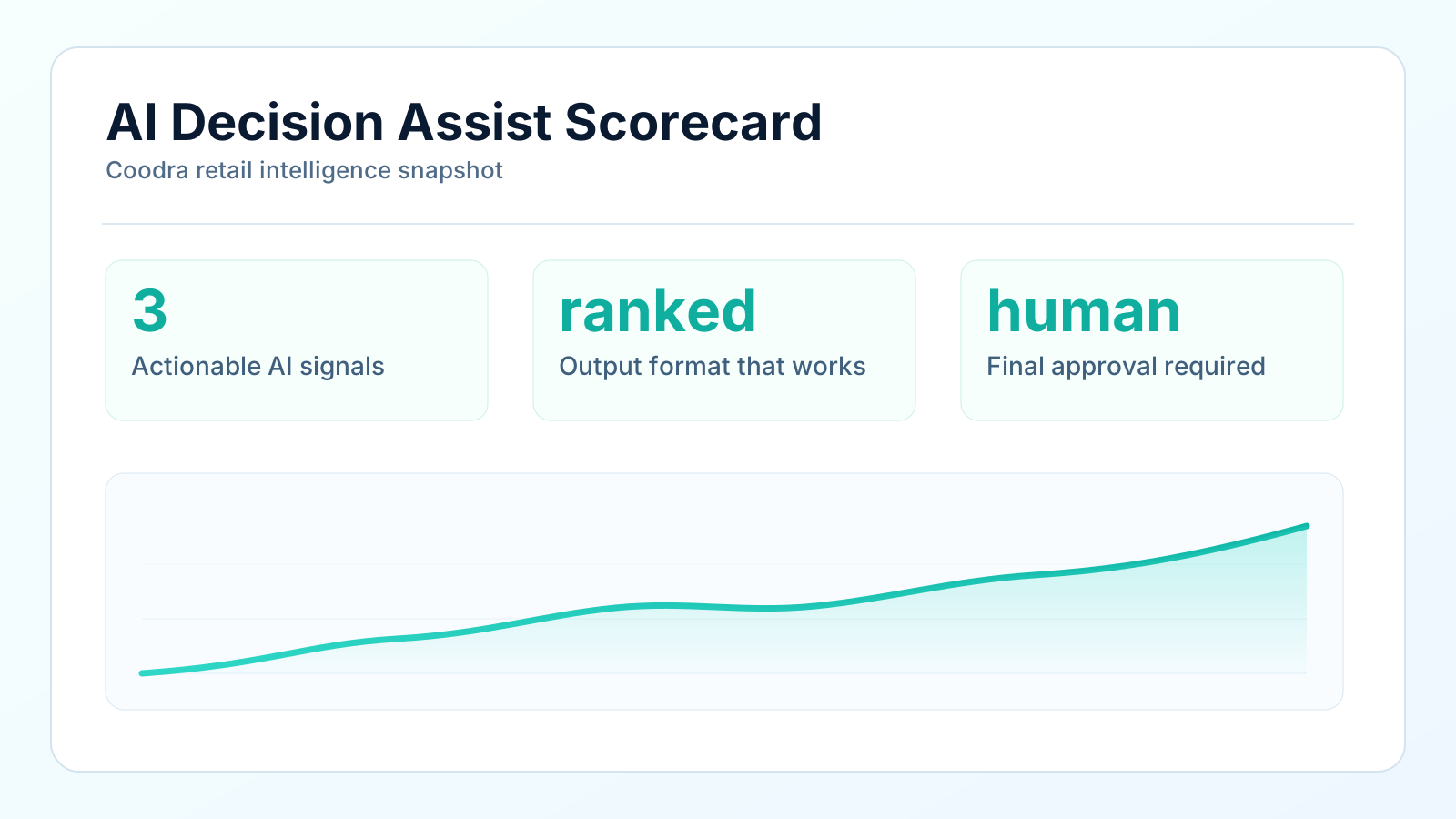
Signal 2: Reorder timing calibrated to actual lead time. The most expensive mistake in independent retail inventory is reordering too late — running out before the new stock arrives. AI that knows your actual distributor lead time, updated from your receiving history, can tell you when to trigger a reorder for each SKU specifically — not based on a generic reorder point, but based on your actual supply chain rhythm.
Signal 3: Margin-weighted ranking. A SKU that is about to stock out is urgent. But urgency and importance are not the same thing. AI that scores every SKU by its contribution to margin — not just its velocity — ranks your reorder list by what matters most to your store, not by alphabetical or alphabetical. A $200 jewelry piece that is about to run out matters more to your margin than a $15 accessory at the same stockout risk.
What AI inventory management does not mean
AI does not replace judgment. No AI system knows that your top-selling SKU just got a mention in a local publication that will drive traffic this weekend. No AI system knows that you are about to run a 20%-off promotion that will spike velocity on three categories. AI gives you a data-backed baseline. Your judgment adjusts from there.
AI also does not fix dirty data. If your POS has SKUs with incorrect names, duplicate entries, or inconsistent category tagging, AI will work from that dirty data and produce dirty outputs. The foundation of any AI inventory management system is clean POS data. If you have not done a periodic audit of your SKU names and category structure, AI amplifies your data — including the errors.
And AI does not run without a POS connection. If the inventory software requires you to manually enter sales data or update inventory counts from a spreadsheet, it is not review-first inventory management — it is a spreadsheet with better UX. The AI layer requires live POS data to function. If you are not connected, you are not getting AI.
What to look for when evaluating AI inventory management vendors
Ask specifically: does this use my actual POS data or do I need to input it manually? If manual input is required, the AI claim is thin. Ask: what is the AI actually scoring, and in what order does it rank the decisions? If the answer is "we show you all your inventory" without a ranking, that is not AI — that is a data display. Ask: can I see the lead time and velocity data the AI is using, and can I override it? If the system does not let you see and adjust the inputs, you are trusting the AI completely — and that is not appropriate for a system making buying decisions with real cash implications.
Coodra is AI inventory management for independent retail: it connects directly to Shopify, Square, Lightspeed, or Clover, scores every SKU by velocity trend and margin contribution, and surfaces the ranked recommendation list every week. See what the decision recommendation surface looks like.
For a comparison of what independent retailers actually need from inventory software versus what enterprise tools provide, see how Coodra compares to Netstock, Cin7, and six other alternatives. The AI question is not "who has the most sophisticated model." The question is: who connects to my POS and gives me a decision I can act on this week.
Primary sources
Was this helpful?