5 inventory mistakes that kill margin (and how to catch them before they do)
A practical framework for spotting hidden inventory drag early and turning signals into high-confidence actions.

Michael Shahid • Founder & CEO
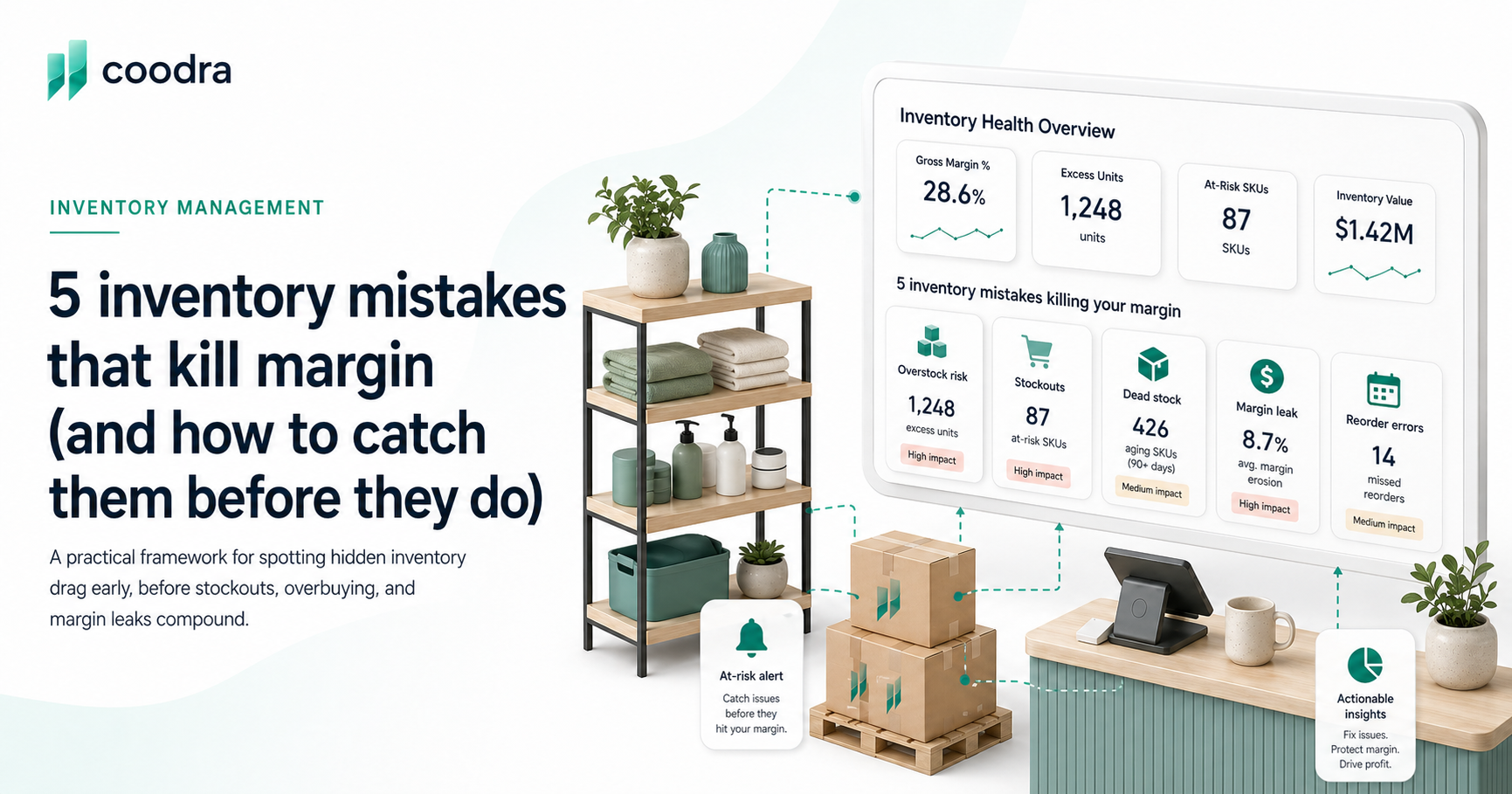
Every retailer has experienced it. You review your numbers at the end of the month and the margin looks worse than it should. Not because of pricing — but because of decisions made weeks earlier, when the signals were already there.
This is the quiet cost of inventory mismanagement. It does not show up as a dramatic loss. It shows up as slow weeks that should have been fast, stock that sat too long, and reorders placed on instinct instead of data.
These five mistakes are the most common. Coodra is built to catch all of them before they compound.
What are the 5 inventory mistakes that kill margin — and how do you catch them early?
Mistake 1: Reordering the same quantities every cycle — regardless of actual demand
Most independent retailers fall into a rhythm: reorder the same SKUs in the same quantities, on the same schedule. It is efficient. It feels safe. It is one of the most expensive habits in retail.
The problem is that demand changes. A product that sold 20 units a week six months ago might now sell 12. If you keep ordering for the old number, you will accumulate dead stock — capital locked up in inventory that sits and eventually forces a discounted clearance sale.
The same applies in reverse. A product that is climbing in velocity is a signal, not just a trend. Ignoring it means you run out at the worst moment: when customers are actively looking and you have nothing to offer.
Coodra surfaces your top sellers and flags when a fast-mover is trending upward before you accidentally reorder below the level that serves your customers. See how it works with your POS.
Mistake 2: No safety stock for high-turn items
Safety stock is not a luxury for enterprise retailers. For any SKU that sells consistently — especially a hero product or a category anchor — running with zero buffer is a known risk that most independent operators take anyway.
When a high-velocity item goes out of stock, you do not just lose that sale. You lose the next three sales while you wait for emergency replenishment. Emergency orders cost more, arrive slower, and often come in incomplete quantities.
A simple safety stock calculation for a consistent seller: multiply your average weekly velocity by two. That is your reorder threshold, not your reorder quantity. Use it to set a trigger, not a target. See the full safety stock method without the complexity.
Coodra flags low-inventory items against your sales velocity every week, so the safety stock conversation happens automatically — not in a manager's head. Connect your POS and get started.
Mistake 3: Reacting to stockouts instead of preventing them
By the time a retailer notices a stockout, the damage is done. The customer went somewhere else. The staff noted the gap. A reorder was placed — usually at a higher cost, with a longer lead time, and with less visibility into the rest of the order cycle.
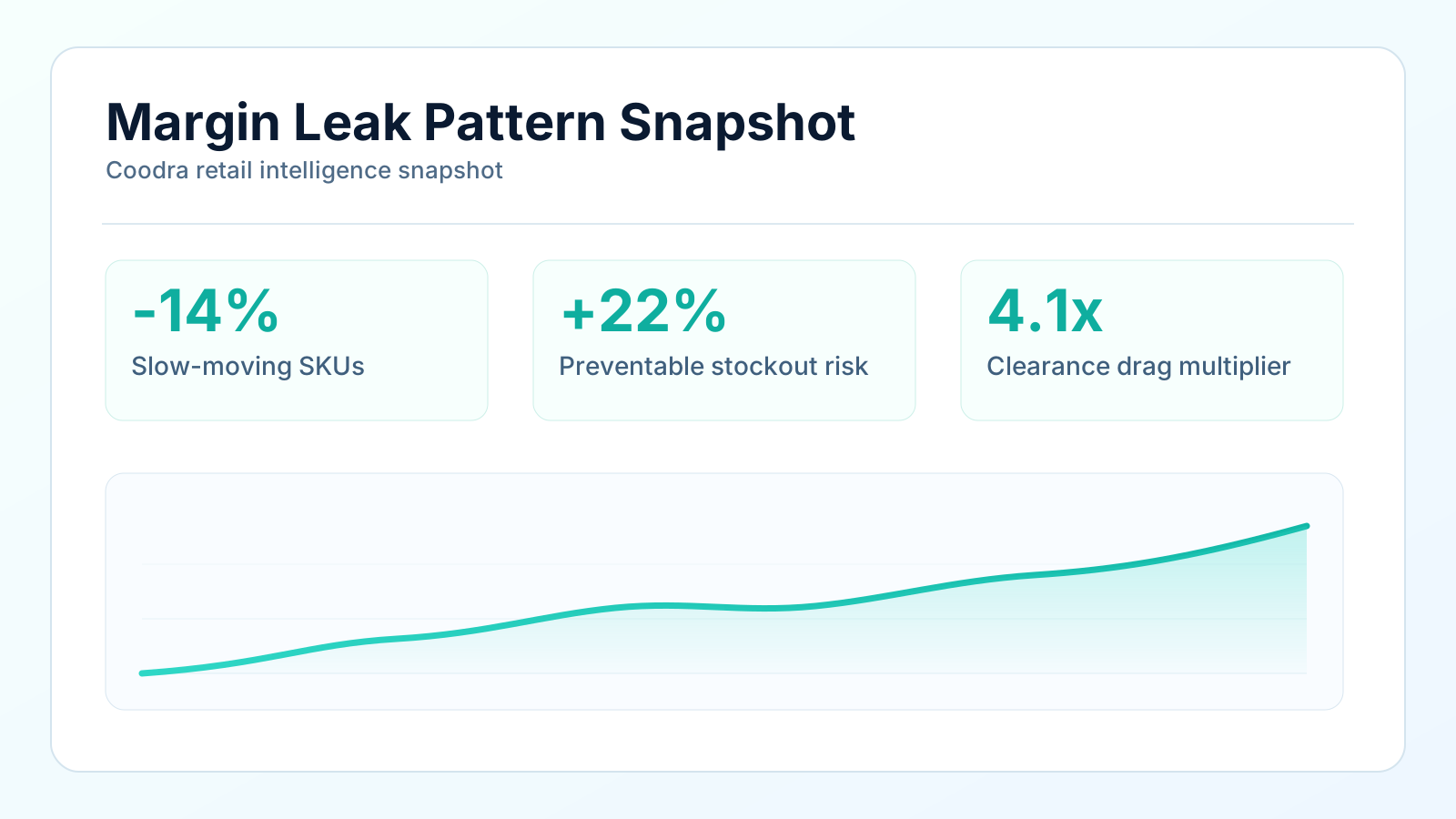
Retailers who manage this well do not react to stockouts. They prevent them with a weekly review: look at what is approaching your reorder point, cross-reference with any known upcoming demand signals (season, promotion, local event), and place orders before the shelf is bare.
This takes 20 minutes a week. The alternative is spending those 20 minutes on the phone explaining to a customer why you do not have the product they came in for.
Coodra's weekly inventory review surfaces these signals in one view — which SKUs are approaching reorder point, which have been trending up, and which have enough buffer to wait. See the weekly review in action.
Mistake 4: Mixing up products with similar names or UPCs
A SKU called "Large Silver Ring" and another called "Large Silver Band" might look different in your system. In your staff's mind, they are the same thing. Mis-picks happen. Counts get confused. Returns get logged to the wrong SKU.
The result is a quiet bleed of inventory accuracy. You think you have 30 of one product. You have 20 of that product and 10 of another. The stock discrepancy does not surface until a manager notices a pattern of adjustments.
Fixing this requires a clean-up of your POS SKU names and a re-labeling of any physically ambiguous items. It is not exciting work. It is the kind of operational maintenance that separates retailers with reliable data from retailers who are always guessing.
Coodra's inventory reconciliation flags SKUs with anomalous movement — which is often the first sign of a mis-pick or count error compounding silently.
Mistake 5: Making purchasing decisions without knowing true cost per SKU
Margin is not just the difference between your price and the supplier's invoice price. It includes freight, handling, shrinkage, and the cost of capital tied up in inventory. A product that appears to deliver a 35% margin might deliver 22% once all of those costs are accounted for.
If you are making reorder decisions on gross margin — or worse, on intuition — you are almost certainly misallocating capital. You are likely over-ordering on products that feel profitable but are not, while under-ordering on products that genuinely deliver strong net margin.
The fix is not complex. Know your landed cost per SKU. At minimum, know your freight-adjusted cost. If you do not have this broken out in your POS data, Coodra can help you surface it from your order history and start ranking SKUs by actual contribution margin rather than top-line revenue. See pricing and plans.
One metric that surfaces this cleanly: the stock-to-sales ratio. If you have more than 4 weeks of supply on hand on a SKU, the carrying cost is quietly eroding your margin — whether or not you have tracked it explicitly. See the warning signs of accumulating dead stock.
These five mistakes are not unique to one type of retailer. The specifics vary — the pattern is the same across jewelry, grocery, pharmacy, and specialty retail.
The question is not whether these mistakes are happening in your store. The question is whether you have a system that catches them before they compound into margin damage you cannot recover in the same quarter. See the five signals that dead stock is already accumulating.
Coodra reviews your sales, inventory, and demand signals every week and surfaces the five decisions most worth acting on — ranked by impact on your margin, not by urgency alone.
Start your free trial and see what your inventory data has been telling you.
Primary sources
Was this helpful?