Shopify vs Square vs Lightspeed: which POS data should you trust for inventory decisions?
How to evaluate signal quality across POS platforms and avoid making critical inventory calls on noisy data.

Michael Shahid • Founder & CEO
There is a persistent assumption in retail inventory planning that serious demand forecasting requires an ERP system. NetSuite, SAP, Epicor — serious planning requires serious software.
For a $3 million independent retailer running Shopify or Square, this assumption is not just wrong. It is actively harmful. It leads operators to either accept inadequate planning or take on a software investment that creates more operational overhead than the inventory problems it was supposed to solve.
The real question is not whether independent retailers can do demand forecasting. It is what level of demand forecasting actually moves the needle for a POS-connected store — and whether ERP-adjacent tools are the best way to get there.
This is what we have found working with retailers across grocery, pharmacy, jewelry, and specialty retail.
Why ERP-first thinking does not serve independent retailers
ERP systems are built for companies with complex supply chains, multiple warehouse locations, and dedicated inventory planners. They assume a certain operational maturity: clean SKU-level data, regular cycle counts, a team member whose job is inventory management.
Most independent retailers do not have any of those things. They have a POS that logs every sale, a once-a-week check on what is running low, and an owner who is making purchasing decisions between customer interactions.
This is not a gap in the retailer's capability. It is a gap in the software market. The tools built for enterprise do not compress well for SMB use cases. You end up paying for modules you will never use, integrations that require IT support, and a learning curve that takes months before the first real planning insight arrives.
Coodra was built specifically for this gap — taking POS data from Shopify, Square, or Lightspeed and turning it into ranked, actionable recommendations without requiring a single ERP configuration. See which POS systems connect to Coodra.
The POS-first demand signal: what your point of sale already knows
Your POS already knows more about your demand patterns than most retailers realize. Every transaction is a data point. The velocity of each SKU, the day-of-week patterns, the seasonal curves, the co-purchasing relationships — it is all in your sales history.
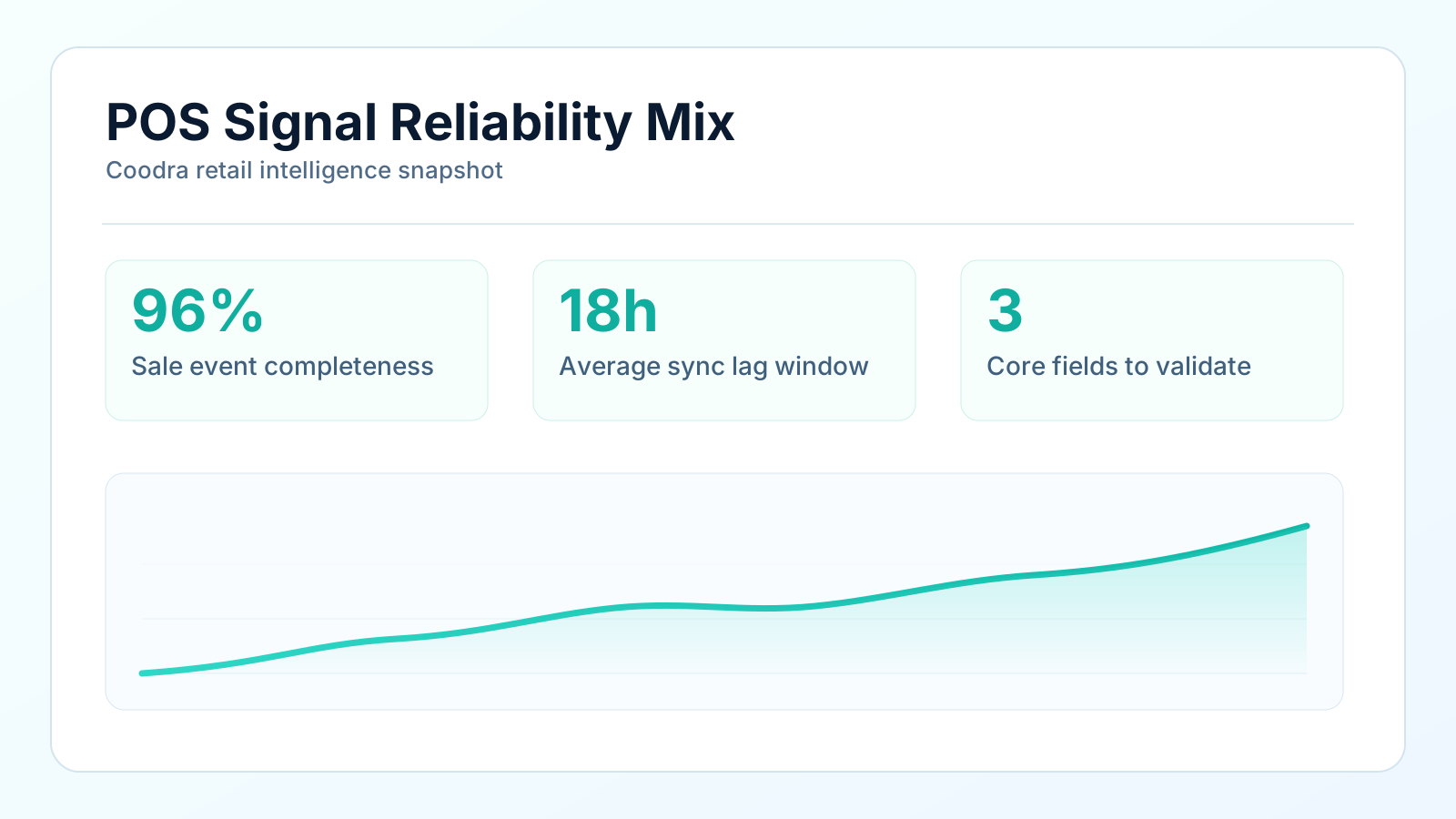
The challenge is not data. It is signal extraction. Raw POS data tells you what sold. It does not tell you what is about to sell, what is about to run out, or which SKU is quietly becoming a faster mover than it was eight weeks ago.
What POS-first demand intelligence does is surface those signals automatically. Coodra pulls your last 90 days of sales and inventory data and generates a ranked list of inventory decisions — which SKUs to reorder now, which to hold, which to reduce. Updated weekly, based on fresh data from your POS.
What good demand forecasting actually looks like at independent scale
For a 2-3 location retailer running Shopify or Square, good demand forecasting does not mean building an AI model. It means answering five questions every week:
Which products am I running low on before they become a stockout?
Which products have I been over-ordering relative to their actual velocity?
Is there a demand trend building on any of my hero SKUs before it shows up as a backorder?
What should I reorder differently this week compared to last week, and why?
Which products are approaching the end of their seasonal cycle and need to be reduced or cleared?
Answering these five questions from your POS data is what Coodra does every week. It does not require an ERP. It does not require a dedicated planner. It requires connecting your POS once and letting the recommendations come to you.
The five outputs are not theoretical. They map directly to margin protection. A missed stockout on your top seller costs you the sale and often the customer. An over-order on a slow-mover costs you the margin on the discounted clearance. Preventing both is what good demand intelligence delivers. See how Coodra pricing works.
The "no ERP required" angle is not a compromise — it is a positioning
Independent retailers who have looked at Coodra and asked "why does this not need an ERP?" are asking the right question from the wrong angle. The question is not why Coodra does not need an ERP. The question is why you would add an ERP to solve a problem your POS already has the data to help you solve.
The ERP market is built for complexity. Coodra is built for the retailer who wants the outcome — better inventory decisions, protected margin, less firefighting — without the overhead of enterprise software. For a full breakdown of how Coodra builds demand forecasts from POS data alone, see our guide to demand forecasting without an ERP.
If you are running Shopify, Square, or Lightspeed and you are spending time wondering whether you need an ERP to do inventory planning justice, the honest answer is: probably not. Apply for early access and see what your data has been telling you.
For a direct comparison with one specific ERP-adjacent alternative, see how Coodra and Netstock stack up for independent retailers.
Primary sources
Was this helpful?