Lead Time and Why It Breaks Every Reorder Formula
Most demand forecasting mistakes are not bad forecasts. They are lead-time errors. Here is why lead time is the variable that quietly destroys most inventory planning — and how to account for it.

Michael Shahid • Founder & CEO
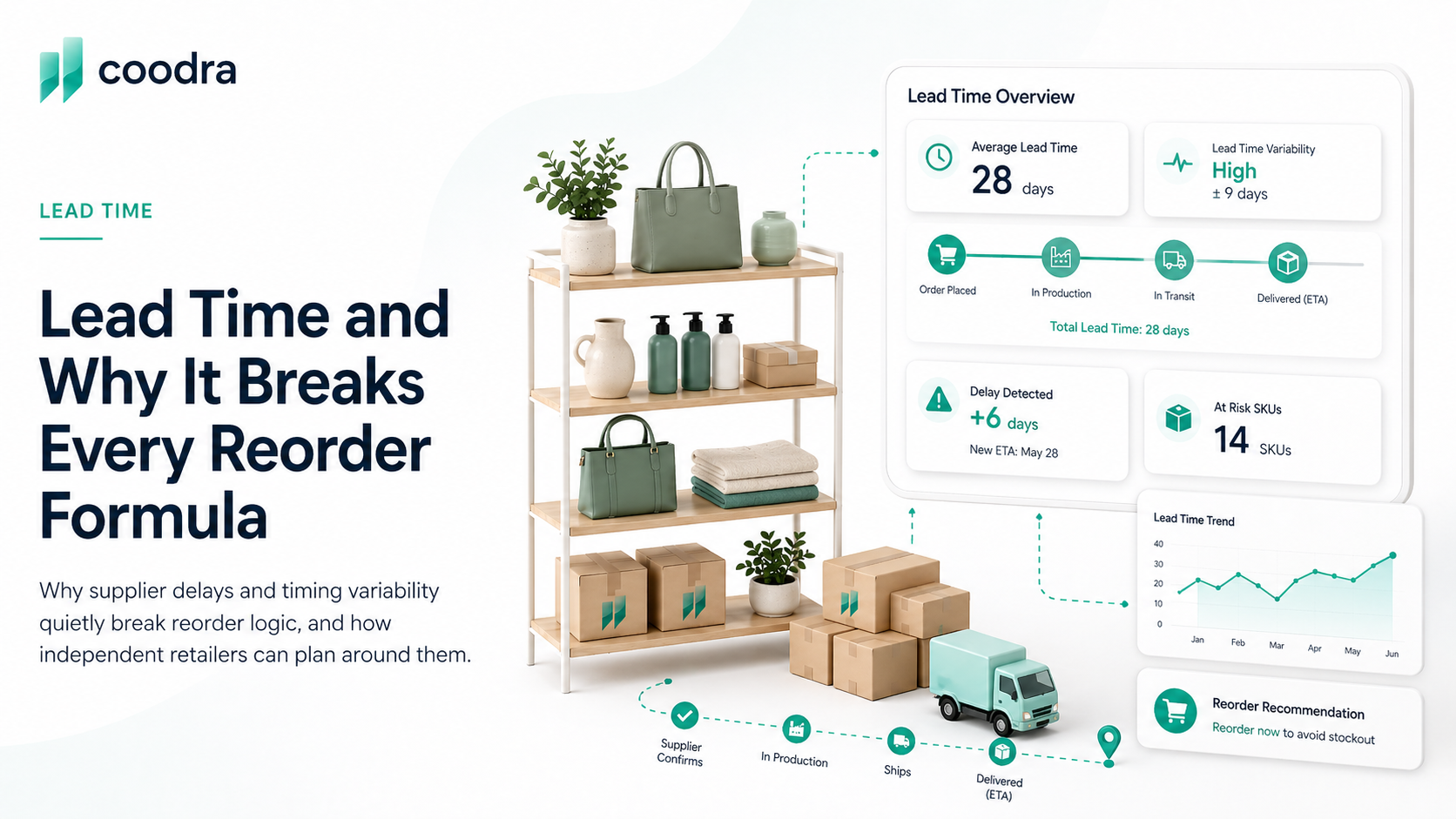
The most common inventory planning mistake has nothing to do with demand forecasting. It is a lead-time mistake. And it is quietly costing independent retailers more than any other single error in their replenishment process.
Here is how it works. A retailer looks at their stock, sees they have 20 units on hand, and places a reorder. The problem: they placed the order based on what demand looks like right now. By the time the product arrives — in 2 weeks, 3 weeks, 5 weeks — demand will have moved. The reorder that felt right when they placed it is wrong by the time it lands.
This is the lead-time gap. It is the distance between the moment you decide to reorder and the moment the product is on your shelf. And it is where most inventory planning falls apart.
Why the formula works in theory but fails in practice
The standard reorder point formula is: Reorder Point = (Average Weekly Sales × Lead Time in Weeks) + Safety Stock. Most retailers know this. Many even use it. And yet their reorder points are still wrong most of the time.
The failure is almost never the math. It is the lead time number. When retailers plug in lead time, they use the supplier's quoted lead time: 2 weeks, 3 weeks, 10 weeks. But the supplier's quoted lead time is not your actual replenishment cycle. Your actual replenishment cycle includes order processing time, shipping, receiving, inspection, and put-away. The real cycle is almost always longer than what the supplier quotes.
If your supplier says 2 weeks but your actual cycle is 3.5 weeks, and you are reordering based on a 2-week lead time, you are under-buffered by a full week on every single order. Guaranteed. Every time.
The week-zero problem: reordering for now instead of for then
The fundamental error is thinking of reorder decisions as responses to current inventory. They are not. A replenishment order is a forecast about what demand will do during the time between now and when the product arrives. You are not ordering for today. You are ordering for 3 weeks from now.
This shifts the question entirely. The right question is not "do I have enough stock?" The right question is "given where demand is trending and how long it will take to arrive, will I have enough stock?" These are different questions. The first one gets you a reorder that is always slightly too late.
The reorder point formula makes this exact adjustment when you use it correctly. The key is using your actual lead time, not your nominal one.
How to find your actual lead time
Your POS data has this already. Look at the gap between when you placed a purchase order and when the product was available to sell. Average that across your last 10 purchase orders per SKU or per category. That is your actual lead time. It will almost always be longer than what your supplier quotes — because suppliers quote their processing time, not your receiving and put-away time.
Do this by category if you can, because lead times vary significantly across categories. A product you dropship might have a 2-week quoted lead time and a 2.5-week actual cycle. A product you import might have a 6-week quoted lead time and a 9-week actual cycle. Treating them the same way is where the errors compound.
Coodra tracks your actual replenishment cycle per SKU automatically from your PO and receiving data, and uses that to calculate whether your current reorder point is appropriately buffered for the real cycle, not the quoted one. See how it connects to your POS and purchase data.
What happens when lead time changes
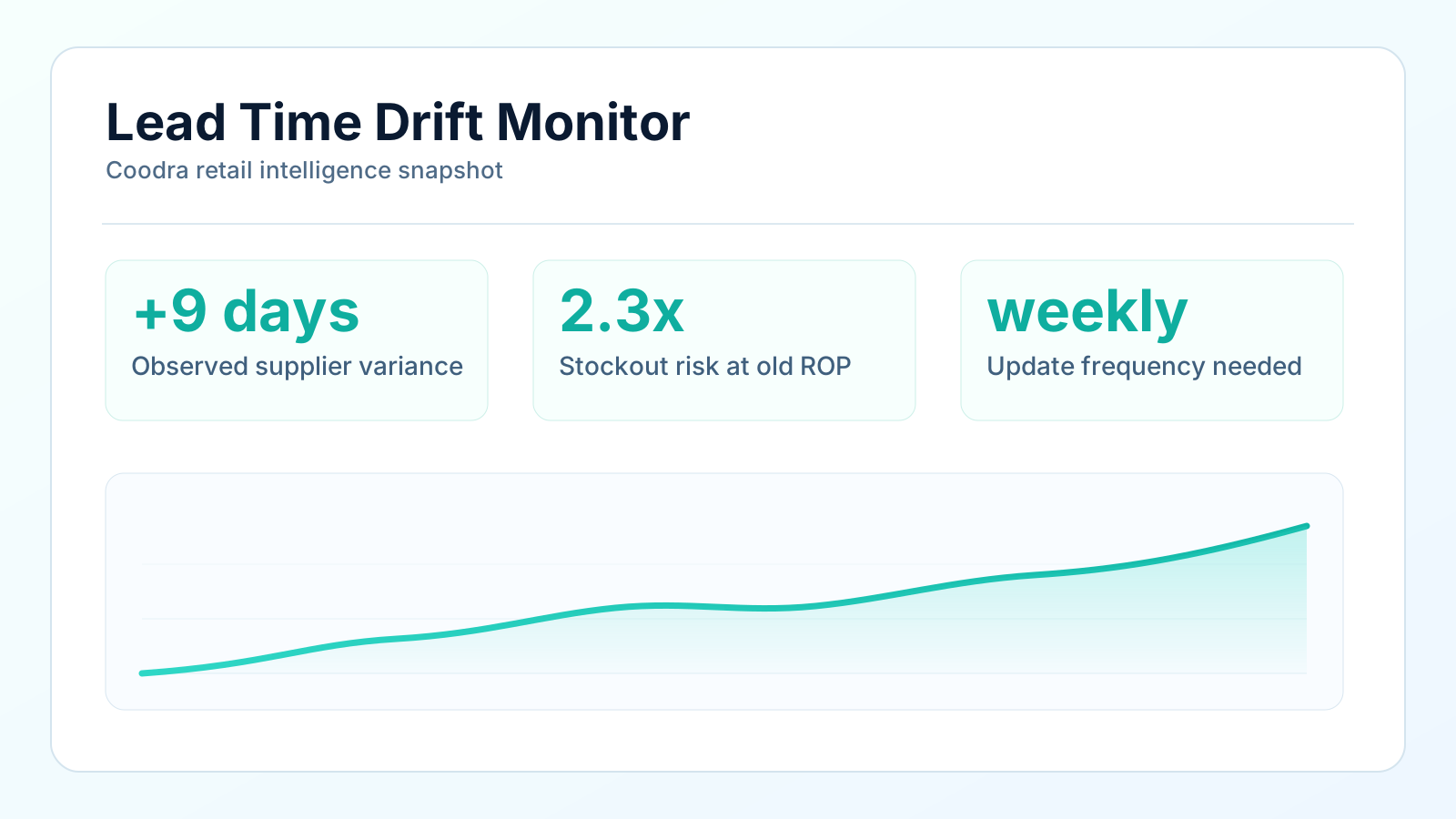
The most invisible lead-time error is a change in supplier lead time that goes unaccounted for. A supplier who was reliably 2 weeks starts running 4 weeks. No one updates the reorder points. The retailer keeps placing the same orders at the same trigger points and keeps running out — blaming the supplier, blaming demand, blaming the POS. It is none of those. It is a lead time change that was never updated in the reorder calculation.
The fix is to treat lead time as a live variable, not a fixed assumption. Check it every quarter. If it has drifted more than a few days from your last measurement, update your reorder points. This one habit prevents a large percentage of the stockouts that feel inexplicable.
When you are placing a large seasonal order — before a holiday season, before a known local event that drives traffic, before a category reset — is exactly when you need to double-check your lead time assumption. Seasonal orders are bigger and the cost of being wrong is larger. If your normal cycle is 3 weeks and the seasonal order is going in during a period when the supplier is overloaded, your actual lead time might be 5 or 6 weeks. Build that in before you confirm the PO.
Lead time is not a number to set once and forget. It is the most dynamic variable in your entire replenishment system, and the one that independent retailers most consistently underestimate. Coodra monitors your lead time per SKU and flags when it has drifted from your baseline — before that drift turns into a stockout on your best sellers.
Primary sources
Was this helpful?