How to Calculate Reorder Points Without Excel
The reorder point formula is simple. The hard part is getting the data and applying it consistently. Here is how to do it with your POS data.

Michael Shahid • Founder & CEO
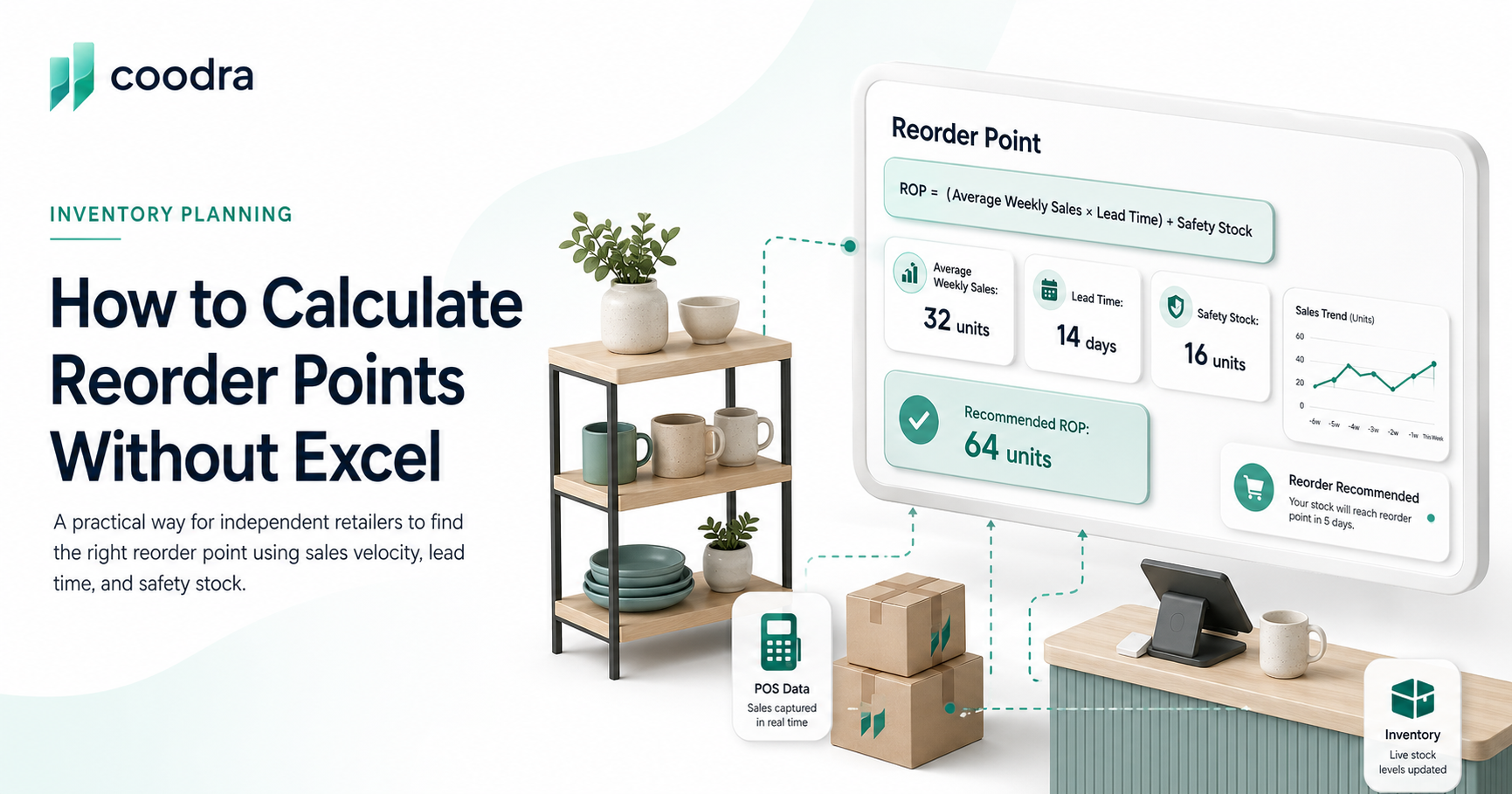
The reorder point is one of the most practical concepts in retail inventory management. It tells you exactly when to place a replenishment order so that you do not run out of stock before the new product arrives. Simple in theory. Hard in practice — because most independent retailers do not have a clean way to calculate and track it consistently.
This post is about the formula, what each variable means for an independent retailer, and how to apply it without building a spreadsheet that requires an accounting degree to maintain.
The reorder point formula for retail: what it is, what each variable means, and how to apply it to your SKUs
The reorder point formula
Reorder Point = Average Weekly Sales × Lead Time (in weeks) + Safety Stock
That is it. Three numbers. The result is the inventory level at which you should trigger your next purchase order — not when the shelf is empty, not when it looks low, but at a specific number that accounts for how long it takes your supplier to get the product to you.
Variable 1: Average weekly sales
Pull the total units sold of a SKU over the last 8-12 weeks from your POS. Divide by the number of weeks. That is your average weekly sales for that product.
Do not use last week alone — one week is too noisy. A consistent 8-12 week view smooths out the variation from promotions, seasonality, or one-time events. If you are in a seasonal business, use the same season from last year as your primary window.
For a product that sells 20 units a week on average, that number is 20.
Variable 2: Lead time in weeks
Lead time is the number of weeks between placing your purchase order and the product being available to sell on your shelf. Ask your supplier directly if you are not sure — most will give you a range. Use the longer end of that range for conservative planning.
If your supplier says 5-7 days, that is approximately 1 week. If they say 3-4 weeks, use 3 or 4. If it varies by product — which is common when you have multiple vendors — calculate this per product or per vendor group.
For a product with a 3-week lead time and 20 units/week average sales, the first part of your calculation is 20 × 3 = 60.
Variable 3: Safety stock
Safety stock is your buffer — the extra inventory you hold to protect against unexpected demand spikes or delayed shipments. The simplest safety stock formula for an independent retailer: average weekly sales × 2. See the full guide to setting safety stock levels without overcomplicating it.
Using the same example: 20 units/week × 2 = 40 units of safety stock.
Your safety stock is not your reorder quantity. It is the minimum buffer you want to maintain above zero. When your inventory hits 40 units on this example SKU, you reorder — you do not wait until it hits zero.
Putting it together
Average weekly sales: 20 units
Lead time: 3 weeks
Safety stock: 40 units
Reorder Point = 20 × 3 + 40 = 100 units
When this SKU drops to 100 units on your inventory count, you place your purchase order. You sell through your remaining stock during the 3-week lead time. By the time you hit your safety stock buffer of 40 units, your reorder is arriving. You should never run out.
This is the theory. The practice problem is doing it for 300, 500, or 1,000 SKUs without living in a spreadsheet. Coodra calculates this for every SKU automatically from your POS sales history, updated weekly, so the reorder decision is not a calculation — it is a review.
Where retailers get this wrong
The most common mistake is using last week's sales as the average. A single week can be wildly unrepresentative — a big one-off order from a single customer, a local event that drove traffic, a promotion that distorted baseline demand. One week of data tells you almost nothing about consistent velocity.
The second mistake is confusing safety stock with reorder quantity. Safety stock is the floor — the point at which you trigger a reorder. Your reorder quantity is how much you order each time. These are two different decisions and should not be the same number.
The third mistake: not updating the calculation when supplier lead times change. If your lead time extends from 2 weeks to 4 weeks, your reorder point changes even if sales velocity is the same. Treat lead time as a live variable, not a fixed one. Lead time is the variable that quietly destroys most reorder formulas.
Coodra monitors your top sellers every week and flags when a product is approaching its reorder point before a stockout happens. Connect your POS to get started.
For a deeper walkthrough of the five questions your POS can answer every week to support this kind of decision-making, see our guide to reading POS data. Demand forecasting without an ERP covers how to build a reliable demand baseline from your POS data alone — no enterprise software required.
Primary sources
Was this helpful?