How to Set Safety Stock Levels Without Overcomplicating It
Most retailers either hold too much safety stock or none at all. Here is the practical middle ground: a simple method that actually gets used.

Michael Shahid • Founder & CEO
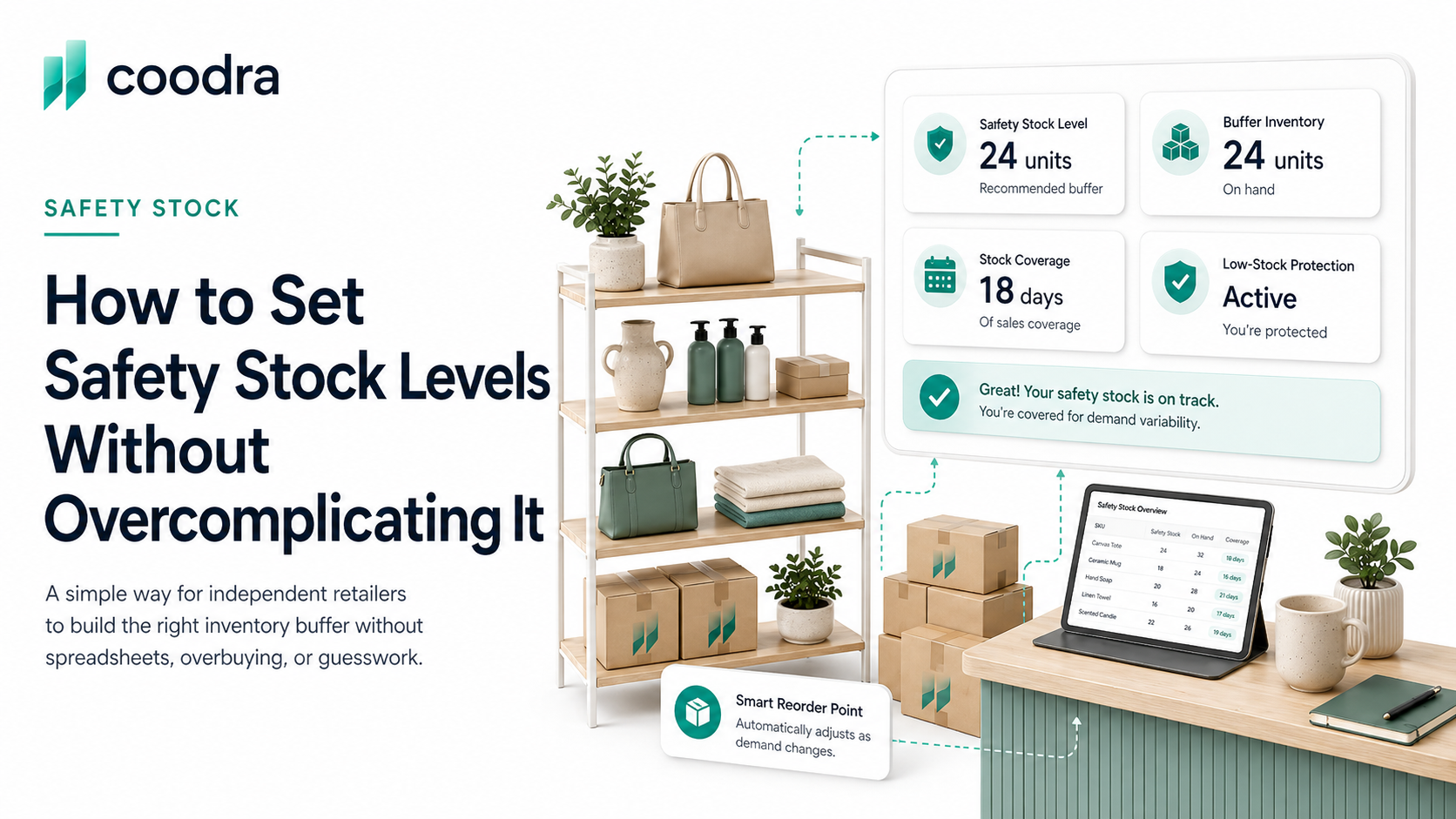
Safety stock is one of those concepts that sounds more complicated than it is. The definition is simple: it is the buffer between your reorder point and the amount you actually want to have on hand when a reorder arrives. The implementation is also simple — until retailers either ignore it entirely or try to calculate it with statistical models designed for supply chain engineers.
Most independent retailers fall into one of two camps. Camp one: no safety stock at all. They reorder when the shelf is empty or when the POS says they are at zero. They are always running just-in-time, which means they are frequently running short. Camp two: excessive safety stock. They over-order everything "just in case" and end up with too much dead stock and capital tied up in inventory that is not selling.
Neither is right. Here is the practical approach that works for independent retail specifically.
The simple method: 2-week velocity buffer
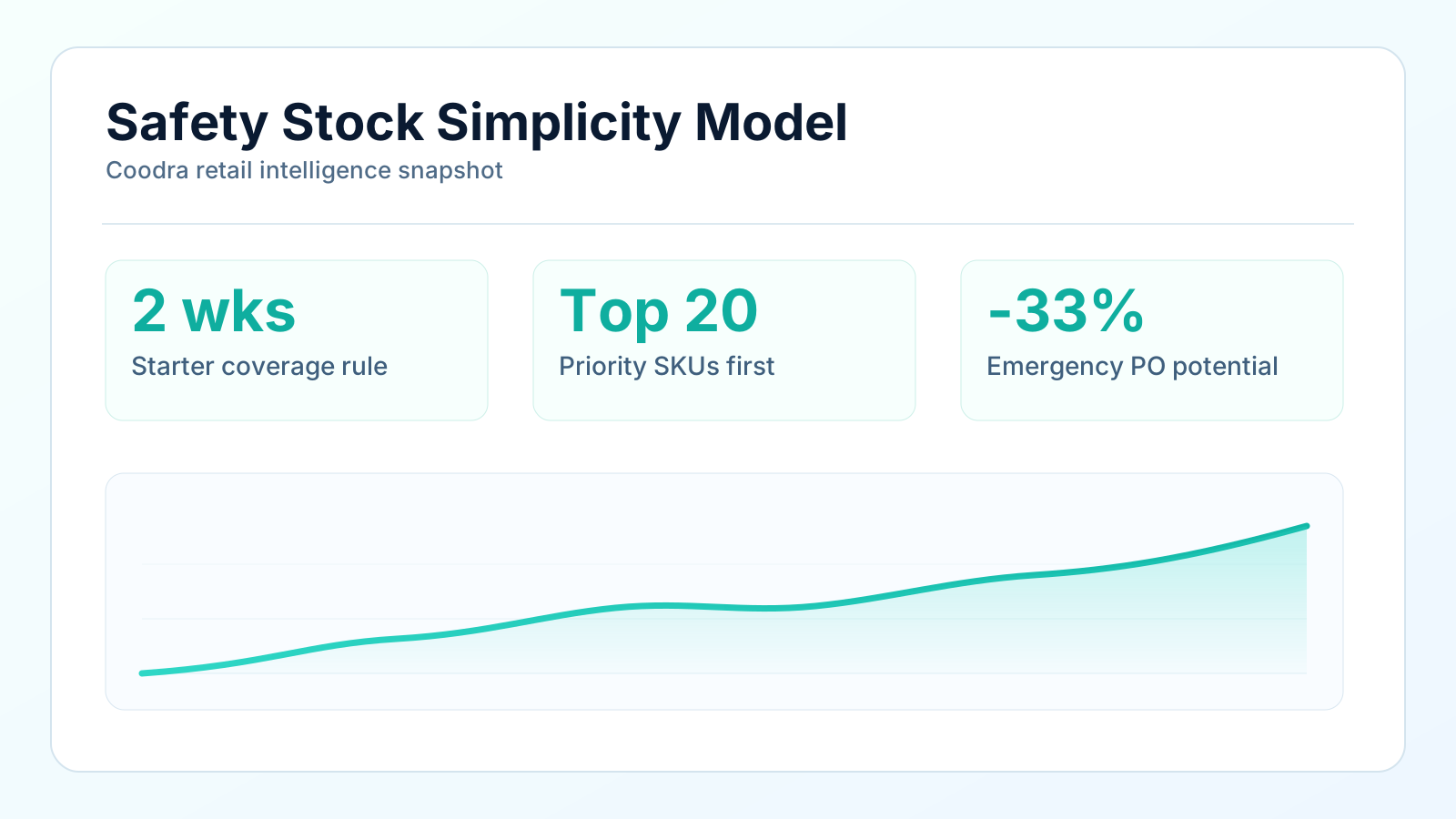
For any SKU that sells consistently — not a novelty item, not a seasonal item, but a consistent performer — your safety stock should equal two weeks of average sales. That is your buffer. It covers the gap between when your stock runs out and when your reorder arrives, plus a small cushion for demand variability.
Two weeks of average sales as a safety stock floor is not a statistical model. It is a practical rule of thumb that works because it matches the reality of most independent retail supply chains. Your lead time is probably 1-3 weeks. Two weeks of buffer means you almost never hit zero before a replenishment order arrives, without holding so much buffer that you are over-extended on capital.
The calculation is: Safety Stock = Average Weekly Sales × 2. Then your Reorder Point = (Average Weekly Sales × Lead Time in Weeks) + Safety Stock. And your Reorder Quantity is how much you order each time — a separate decision from safety stock, and one that should be based on your supplier's minimum order quantity and your physical storage capacity.
When to hold more than 2 weeks
Two weeks is the baseline. Some SKUs warrant more. The criteria: how critical is this product to your store, how variable is your supply lead time, and how expensive is a stockout relative to the cost of holding slightly more buffer.
Your top 3-5 hero products — the ones customers come in specifically asking for, the ones that anchor a category — probably deserve 3-4 weeks of safety stock. The cost of running out on your best seller is higher than the carrying cost of holding an extra week of inventory. For these SKUs, the buffer should be explicitly set higher.
Products with erratic or unpredictable lead times also deserve more buffer. If a supplier runs 2 weeks most of the time but occasionally stretches to 5, a 2-week safety stock will leave you short half the time. Push it to 3-4 weeks for these suppliers.
Seasonal products entering their selling season should also carry more buffer initially — because you are building inventory for a known demand curve, not filling ongoing orders. If you are buying for holiday and the selling season is 8 weeks, your safety stock at the start of the season should reflect not just lead time variability but the cost of running out mid-season when reordering is no longer an option.
Coodra flags high-velocity SKUs that are running below a 2-week buffer and surfaces them before they hit the danger zone. Connect your POS to see which of your SKUs are under-buffered.
When you can get away with less than 2 weeks
Two weeks is the right default. There are exactly two situations where less makes sense: ultra-reliable, ultra-fast suppliers, and low-criticality products where a stockout has no lasting cost.
If your supplier consistently delivers in 3-5 days and you can count on that reliability, you might drop to a 1-week buffer on consistent sellers. But only if you are actually watching your inventory levels weekly and willing to place emergency orders without penalty. If you are not checking weekly, do not reduce the buffer.
If a product is truly low-stakes — a product a customer can substitute easily, a product that represents less than 1% of your revenue — a zero safety stock might be fine. The cost of a stockout is low and the capital tied up in buffer is not worth it. The key is being honest about whether a product is genuinely low-stakes or whether you are just underweighting the cost of a stockout because it has not happened yet.
The review cadence: how often to update safety stock levels
Once a quarter is enough for most retailers. Pull your average weekly sales for the last 4-6 weeks on each SKU and update the safety stock calculation. If the average has moved meaningfully — more than 20% in either direction — update the reorder point. If it has not moved meaningfully, leave it.
The retailers who get this right are not doing more work than everyone else. They are doing the same work — reviewing their top SKUs weekly — but they are running the calculation, not just eyeballing it. The calculation takes 30 seconds per SKU once you have the data. That is the difference between a safety stock that works and one that is either too thin to prevent stockouts or too thick to tie up capital unnecessarily.
Coodra calculates and monitors safety stock levels automatically for every SKU in your POS, updated every week, so the buffer is always based on recent velocity rather than a number set once and forgotten. Apply for early access and see which SKUs are under-buffered this week.
Primary sources
Was this helpful?